
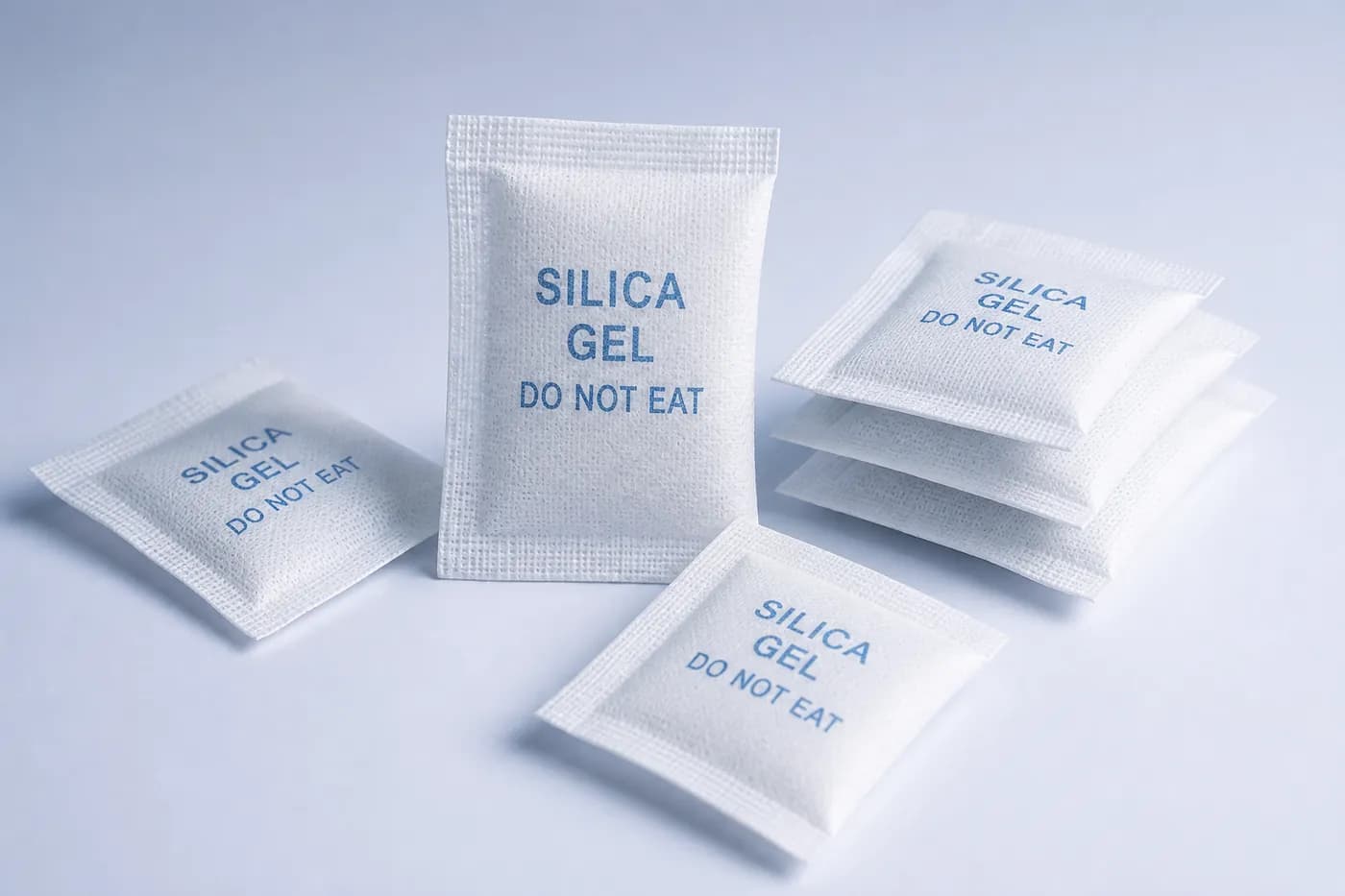
One of the most common questions we get is simply: how much silica gel do I need? Get it wrong and either the desiccant saturates before your product reaches the customer, or you spend more than necessary. This guide gives you a practical way to estimate the right quantity.
The quick rule of thumb
For most sealed packaging, start with about 1 gram of silica gel per 30–40 cm³ (or roughly per litre for loosely sealed packs) of enclosed air, then adjust up for humid climates, long transit times and moisture-sensitive products. It is safer to slightly over-dose than under-dose.
Typical quantities by package type
| Package | Typical desiccant |
|---|---|
| Medicine / supplement bottle | 0.5 g – 2 g sachet |
| Small electronics box / pouch | 5 g – 10 g |
| Shoe box / handbag | 10 g – 25 g |
| Standard shipping carton | 25 g – 50 g |
| Pallet load | 100 g – 500 g |
| 20-ft shipping container | Several kg (see below) |
Four factors that change the amount
- Sealed volume: bigger enclosed space needs more desiccant.
- Humidity & climate: tropical and monsoon routes need more.
- Transit & storage time: longer journeys need more capacity.
- Barrier quality: a good moisture-barrier bag dramatically reduces how much you need; an open carton needs more.
Shipping containers & container rain
Full containers are a special case because of container rain — condensation that drips onto cargo. Exporters commonly use several kilograms of desiccant per 20-ft container, using high-capacity silica gel or economical clay desiccant. See our packaging & logistics guidance for details.
Still not sure?
Every product is different, so treat these as starting points. Send us your packaging dimensions, product type and shipping route and we'll calculate the exact grammage. Request a recommendation →